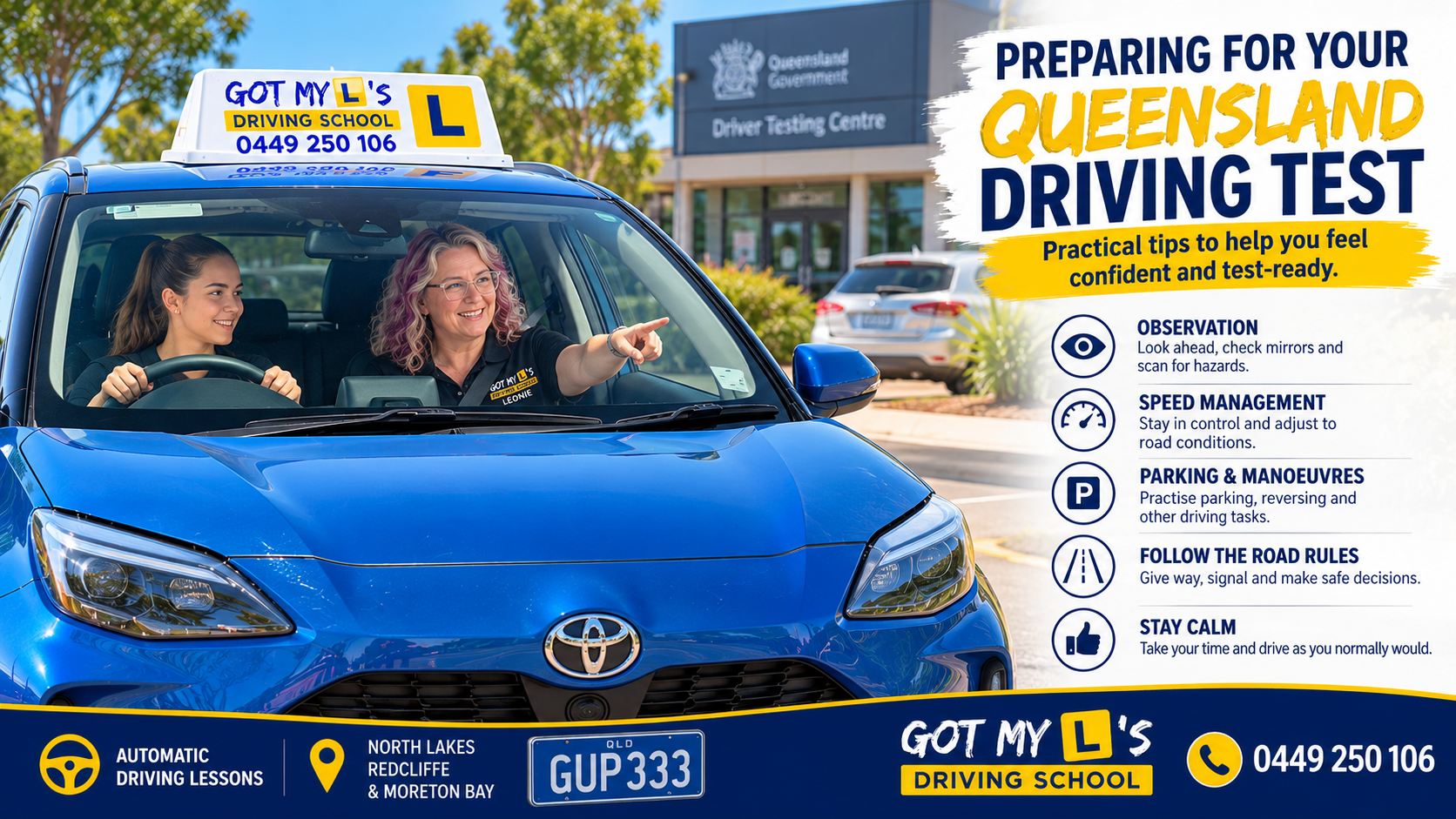
Preparing for Your Queensland Driving Test: Tips to Help You Pass
Getting ready to go from your L plates to your P plates? Taking your practical driving test is an exciting milestone, but it's also normal to feel a little nervous.
Whether you're preparing for your driving test at Redcliffe, Caboolture or another Queensland testing centre, good preparation can make all the difference.
At Got My L's Driving School, we help learner drivers throughout North Lakes, Redcliffe and surrounding Moreton Bay suburbs develop the skills, confidence and safe driving habits needed for their practical driving test.
Here's what you need to know before test day.
1. Make Sure You're Eligible to Take Your Driving Test
Before booking your Queensland practical driving test, make sure you've completed the necessary requirements.
For learner drivers under 25, these generally include:
-
Holding your learner licence for at least 12 months.
-
Completing 100 hours of supervised driving, including 10 hours at night.
-
Having your learner logbook approved by the Department of Transport and Main Roads (TMR).
-
Successfully completing the Hazard Perception Test.
-
Being at least 17 years old.
Learner drivers aged 25 and over do not need to complete the 100-hour logbook, but must still meet the other applicable licensing requirements.
It's important to check your eligibility before booking to avoid unnecessary delays.
2. Understand What the Driving Examiner Is Looking For
The Queensland practical driving test isn't about being a perfect driver. It's about demonstrating that you can operate a vehicle safely, independently and confidently while following the road rules.
During your test, the examiner will assess skills such as:
-
Observation: Regularly checking mirrors, blind spots and the road environment.
-
Speed management: Maintaining appropriate speeds and adjusting to road conditions.
-
Road positioning: Keeping your vehicle correctly positioned within your lane.
-
Intersections and roundabouts: Applying give-way rules and making safe decisions.
-
Signalling: Communicating your intentions clearly and at the appropriate time.
-
Vehicle control: Demonstrating smooth steering, braking and acceleration.
-
Manoeuvres: Safely completing parking, reversing and other requested driving tasks.
Remember, the examiner wants to see safe and consistent driving, not rushed decisions.
3. Practise in Different Driving Conditions
One of the best ways to prepare for your practical driving test is to gain experience in a variety of traffic conditions.
Don't limit your practice to quiet suburban streets. Spend time driving through busier intersections, multi-lane roads, roundabouts, school zones and areas with changing speed limits.
For learners around North Lakes and Redcliffe, practising in different parts of the Moreton Bay region can help build confidence in unfamiliar situations.
The aim isn't to memorise a particular driving test route. It's to develop the ability to drive safely wherever the examiner directs you.
4. Focus on Observation and Hazard Awareness
Good observation is one of the most important skills you'll demonstrate during your driving test.
Make sure you're regularly checking your mirrors, looking ahead for potential hazards and performing head checks when required.
Pay particular attention to:
-
Checking blind spots before changing lanes.
-
Looking carefully for pedestrians and cyclists.
-
Approaching intersections at a safe speed.
-
Watching for vehicles entering or leaving driveways.
-
Identifying changing road conditions early.
Even if your vehicle has a reversing camera or blind-spot monitoring, you must still demonstrate proper observation.
A good driving habit is to look early, identify potential hazards and give yourself enough time to respond safely.
5. Practise Your Parking and Driving Manoeuvres
Many learner drivers feel nervous about parking and reversing during their driving test.
The best way to build confidence is through regular practice.
Depending on the test, you may be asked to demonstrate manoeuvres such as reverse parking, a U-turn or a three-point turn.
Focus on completing each manoeuvre slowly, safely and with good observation.
Don't worry about trying to perform everything as quickly as possible. Taking the time to check your surroundings and maintain control is far more important.
6. Consider a Driving Lesson Before Your Test
Even if you've completed your required driving hours, a professional driving lesson before your test can be extremely valuable.
An experienced driving instructor can help identify habits you might not realise you've developed, such as missing head checks, approaching roundabouts too quickly or forgetting to check speed limits.
At Got My L's Driving School, our automatic driving lessons are tailored to your individual needs.
We can work on the areas where you need improvement and help you feel more confident before your practical driving test.
7. Prepare for Test Day
A little organisation can help reduce unnecessary stress on the day of your test.
Before leaving home, make sure you:
-
Get a good night's sleep.
-
Allow plenty of time to arrive at the testing centre at least 20 minutes early.
-
Bring your learner licence and any other required documentation.
-
Have your glasses or contact lenses if required for driving.
-
Ensure the test vehicle is registered, roadworthy and meets TMR requirements.
-
Check that your mobile phone is switched off before the test begins.
If you're using your own vehicle, check its lights, tyres, indicators and other essential equipment beforehand.
8. Stay Calm and Listen to the Examiner
It's perfectly normal to feel nervous during your driving test.
Try to concentrate on one instruction at a time and drive as you normally would during a well-practised lesson.
If you don't understand an instruction, ask the examiner to clarify it before proceeding.
If you make a small mistake, don't assume you've failed. Continue concentrating on safe driving rather than worrying about something that has already happened.
The important thing is to remain focused, follow the road rules and make safe decisions throughout the test.
9. What Happens After Your Driving Test?
At the end of your practical driving test, the examiner will discuss your result with you.
If you've passed, congratulations! You'll be able to complete the necessary licensing steps before driving independently under the conditions of your new licence.
If you haven't passed, use the examiner's feedback to identify the areas that need improvement.
A few additional driving lessons and some focused practice can help you prepare for your next attempt.
Remember, becoming a safe and confident driver is more important than passing on a particular day.
Get Ready for Your Driving Test with Got My L's Driving School
Preparing for your Queensland driving test doesn't have to be stressful.
With regular practice, an understanding of the road rules and guidance from a qualified driving instructor, you can approach test day feeling more confident and prepared.
Got My L's Driving School offers friendly, professional automatic driving lessons throughout North Lakes, Redcliffe, Mango Hill, Rothwell, Kallangur, Deception Bay and surrounding suburbs.
Whether you're just starting your driving journey or getting ready for your practical driving test, we're here to help you develop safe driving skills that last well beyond your P plates.
Ready to build your confidence behind the wheel? Contact Got My L's Driving School to book your next automatic driving lesson.
Frequently Asked Questions
How long does the Queensland practical driving test take?
A Queensland Class C practical driving test generally involves approximately 25–35 minutes of on-road assessment.
Do I need to pass the Hazard Perception Test first?
Yes. Queensland learner drivers must pass the Hazard Perception Test before booking their practical driving test.
Can I use an automatic car for my driving test?
Yes. You can complete your Queensland practical driving test in an automatic vehicle. However, passing in an automatic car will generally result in an automatic transmission licence condition.
What happens if I make a mistake during my driving test?
Not every mistake results in an automatic fail. However, serious safety-related errors can result in the test being terminated. The examiner assesses your performance against Queensland's Q-SAFE requirements.
Should I have a driving lesson before my test?
A lesson before your test can help you identify areas for improvement, practise essential driving skills and build confidence before the assessment.