Night Driving Tips for Learner Drivers in Queensland (2026)
Driving at night can feel intimidating when you're learning, but it doesn't have to be.
Reduced visibility, headlight glare, tiredness and unexpected hazards all make night driving more challenging than driving during the day. The good news is that with the right preparation and plenty of practice, night driving quickly becomes another valuable skill.
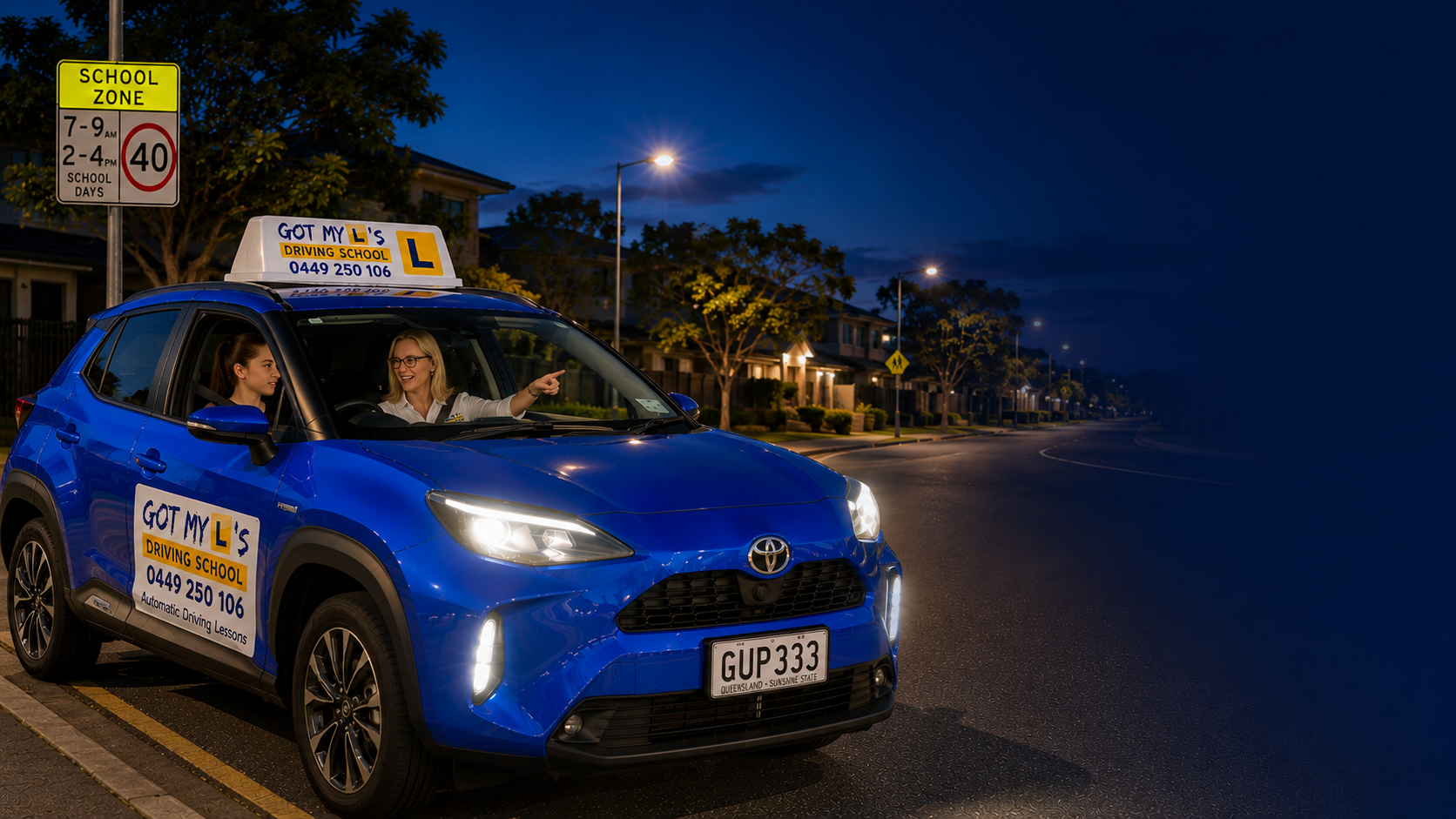
At Got My L's Driving School, Leonie helps learner drivers throughout Redcliffe, North Lakes, Rothwell, Mango Hill and surrounding Moreton Bay suburbs build confidence in all driving conditions—including after dark.
Why Night Driving Is More Challenging
When the sun goes down, your eyes simply don't receive as much information.
At night you have:
- Reduced visibility
- Less time to react
- Increased headlight glare
- More difficulty judging speed and distance
- Greater risk of driver fatigue
- Increased wildlife activity on rural roads
Learning how to recognise these hazards early is one of the best ways to become a safe and confident driver.
Before You Drive
Taking a few minutes to prepare your vehicle makes a huge difference to your safety.
Before every night drive:
✔ Clean your windscreen inside and out
✔ Check headlights are clean and working correctly
✔ Ensure brake lights and indicators are operating
✔ Check tyre pressures
✔ Make sure washer fluid is full
✔ Adjust mirrors before leaving
✔ Set your GPS before driving
Good preparation allows you to concentrate on the road instead of worrying about your vehicle.
Use Your Headlights Correctly
Many learner drivers are unsure when to use high beam and low beam.
Low Beam
Use low beam:
- In built-up areas
- When another vehicle is approaching
- When following another vehicle
High Beam
Use high beam:
- On dark rural roads
- When there is little or no street lighting
- When it is safe and legal
Always dip your headlights well before another vehicle approaches to avoid dazzling other drivers.
Reduce Glare
Headlight glare is one of the biggest challenges for new drivers.
If an oncoming vehicle has bright headlights:
- Look slightly towards the left edge of your lane
- Avoid staring directly into the lights
- Keep both hands on the steering wheel
- Maintain a steady speed
- Don't panic or brake suddenly
Your vision will recover much faster if you avoid looking directly at the approaching lights.
Slow Down at Night
Your stopping distance doesn't change at night—but your ability to see hazards does.
Drive at a speed that allows you to stop safely within the distance illuminated by your headlights.
Remember:
- Pedestrians may be difficult to see
- Cyclists often appear suddenly
- Wildlife can enter the road without warning
- Parked vehicles may hide people crossing
Night driving is about observation, not speed.
Watch for Fatigue
Fatigue is one of the biggest contributors to serious crashes on Australian roads.
Common warning signs include:
- Frequent yawning
- Heavy eyelids
- Drifting within your lane
- Missing road signs
- Difficulty concentrating
- Slower reaction times
If you feel tired, don't try to "push through."
Instead:
✔ Pull over somewhere safe
✔ Stretch your legs
✔ Drink some water
✔ Swap drivers if possible
No destination is worth risking your safety.
Be Extra Careful in Wet Weather
Rain makes night driving even more difficult.
Headlights reflect off wet roads, reducing visibility.
During wet weather:
- Increase your following distance
- Slow down earlier
- Brake gently
- Use low beam headlights
- Avoid sudden steering movements
Smooth driving is always the safest approach.
Wildlife Awareness
If you're travelling outside built-up areas, wildlife becomes a serious hazard.
Kangaroos, wallabies and other animals are most active:
- Around sunrise
- Around sunset
- During the night
If you see one animal, expect there may be more nearby.
Never swerve suddenly.
Brake firmly in a straight line while maintaining control of your vehicle.
Night Driving Test Preparation
Many learner drivers don't realise how much night driving improves their overall skills.
Practising after dark helps you become more confident with:
- Hazard perception
- Observation
- Judging speed and distance
- Mirror checks
- Smooth steering
- Defensive driving
The more experience you gain in different driving conditions, the more prepared you'll be for driving independently after passing your test.
Leonie's Tips for Learner Drivers
After helping hundreds of learner drivers throughout Moreton Bay, Leonie recommends:
✔ Look further ahead than you think you need to.
✔ Slow down early rather than braking hard.
✔ Keep your windscreen spotless.
✔ Leave extra space between you and the vehicle ahead.
✔ Don't let impatient drivers pressure you.
✔ If you're unsure, slow down and assess the situation.
Confidence comes from experience—not rushing.
Safe Night Driving Checklist
Before every night drive:
✅ Clean windows and mirrors
✅ Check headlights and brake lights
✅ Adjust mirrors
✅ Plan your route
✅ Make sure you're well rested
✅ Carry water for longer trips
✅ Avoid distractions
✅ Drive smoothly and stay alert
Small habits like these quickly become second nature and make every journey safer.
Learn to Drive with Confidence
Night driving doesn't need to be stressful.
With professional instruction, plenty of practice and the right techniques, you'll quickly become comfortable driving after dark.
At Got My L's Driving School, Leonie provides patient, personalised automatic driving lessons that help learner drivers build confidence in both day and night driving.
Why choose Got My L's Driving School?
✔ Accredited Queensland Driving Instructor
✔ Modern Toyota Yaris Cross Hybrid
✔ Dual-Control Vehicle
✔ Calm and Patient Coaching
✔ Progress Updates After Lessons
✔ Driving Test Preparation
📞 Book your lesson today: 0449 250 106