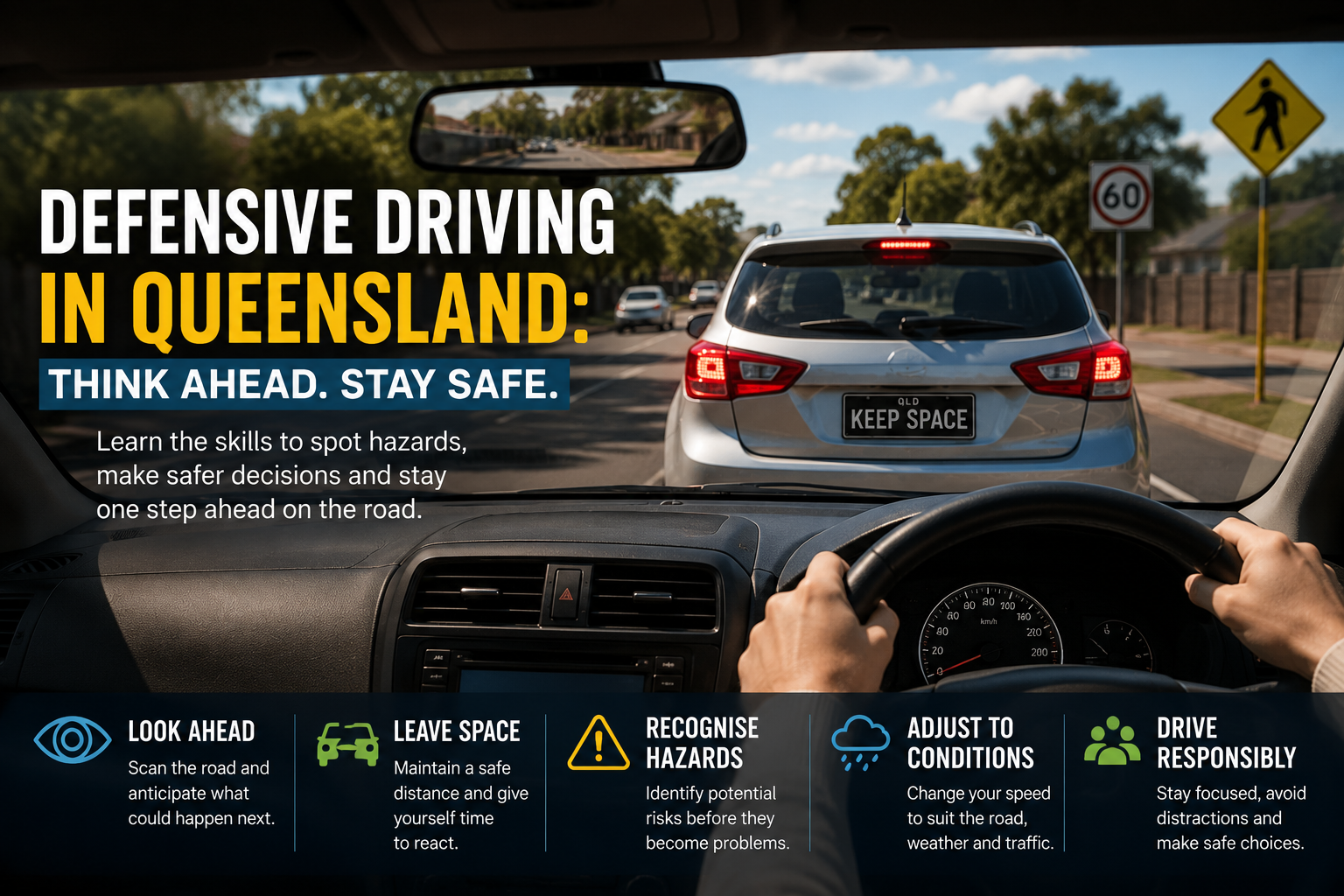
Defensive Driving in Queensland: How to Think Ahead and Stay Safer on the Road
Learning to drive is about much more than steering, braking and following the road rules. A safe driver is constantly looking ahead, noticing what is happening around them and giving themselves enough time and space to respond.
That is the real idea behind defensive driving.
Defensive driving does not mean driving nervously or expecting every other road user to make a mistake. It means recognising that traffic situations can change quickly and developing the habits needed to spot potential problems before they become emergencies.
For learner and new drivers in Queensland, these skills are especially important. Queensland's driver education guidance places a strong emphasis on gaining experience, recognising hazards and learning how to respond safely to changing road situations.
At Got My L's Driving School, we believe learning to drive should be about more than simply getting through the practical driving test. The goal is to help drivers develop the awareness, judgement and confidence they need to continue driving safely after they get their licence.
What Is Defensive Driving?
Defensive driving is the ability to:
- Look well ahead rather than focusing only on the car directly in front.
- Scan the road and surrounding environment for potential hazards.
- Recognise situations that could develop into a problem.
- Maintain enough space to safely respond.
- Adjust your speed to the road, weather and traffic conditions.
- Anticipate the actions of other road users.
- Avoid distractions and stay focused on driving.
Queensland's hazard perception guidance describes this process simply as:
Scan. Recognise. Respond.
A driver who identifies a potential problem early has more options. They may be able to slow down gradually, create more space, change their road position or simply prepare for what might happen next.
Waiting until a hazard is directly in front of you often means you have fewer safe options available.
Why Thinking Ahead Makes You a Safer Driver
One of the biggest differences between an inexperienced driver and an experienced driver is often not their ability to physically control the car.
It is what they are looking for.
A new driver may focus heavily on:
- Keeping the vehicle centred in the lane.
- Watching the vehicle immediately ahead.
- Remembering which road rule applies.
- Operating the controls correctly.
As these skills become more automatic, the driver can spend more attention looking further ahead and monitoring what is happening around them.
For example, imagine you are travelling behind several vehicles and notice a car three or four vehicles ahead slowing down and indicating.
A driver who is only watching the vehicle directly in front may not react until that driver brakes.
A driver who is scanning ahead can recognise what is developing and begin adjusting their speed earlier.
That extra time can make a significant difference.
Queensland's learner-driver guidance specifically encourages drivers to look beyond the vehicle immediately in front and scan the wider road environment for developing hazards.
The Three Steps of Good Hazard Perception
Hazard perception is an important part of becoming a safe driver. In Queensland, learner drivers must pass the hazard perception test before booking their practical driving test. The skill itself, however, is something that continues developing through experience.
1. Scan
Scanning means actively looking around the driving environment rather than staring at one point.
A good driver regularly checks:
- The road well ahead.
- The vehicle in front.
- Traffic approaching intersections.
- Pedestrians and cyclists.
- Parked vehicles.
- Side streets and driveways.
- Road signs and changing conditions.
- Their mirrors and surrounding traffic.
The key is to keep gathering information.
A parked car may be nothing to worry about—or it may have someone about to open a door.
A pedestrian standing on the footpath may remain there—or they may be about to cross the road.
A vehicle waiting at an intersection may stay where it is—or pull into your path.
Scanning gives you the opportunity to notice these situations early.
2. Recognise
Not everything you see is an immediate danger.
The next step is recognising which situations could potentially affect you.
For example:
- A child playing near the road.
- A vehicle indicating ahead.
- A car approaching an intersection quickly.
- Brake lights several vehicles in front.
- A cyclist moving around parked cars.
- A wet road surface.
- Traffic suddenly slowing.
Good drivers begin asking themselves:
"What could happen next?"
This does not mean assuming the worst. It means being prepared for the possibility.
3. Respond
Once you recognise a hazard, you can make a safer and more considered decision.
Your response might involve:
- Reducing speed.
- Increasing your following distance.
- Covering the brake.
- Checking your mirrors.
- Changing your road position when safe.
- Preparing to stop.
- Giving another road user more space.
The earlier you identify the problem, the smoother and safer your response can usually be.
Defensive Driving Is About Creating Space
Space is one of the most valuable safety tools available to a driver.
If you leave yourself enough space, you have more time to think and respond.
If you drive too close to another vehicle, approach hazards too quickly or position yourself where you have limited escape options, your choices become much more limited.
Following Distance Matters
Queensland Government guidance recommends allowing at least a two-second gap behind the vehicle in front in ideal conditions.
That distance should increase when conditions are poor, including when roads are wet or visibility is reduced. Drivers towing a trailer or caravan also need additional space.
A simple way to check your following distance is to choose a fixed object beside the road.
When the rear of the vehicle ahead passes the object, begin counting:
"One thousand and one, one thousand and two."
If you reach that same point before you finish counting, you are following too closely.
The important thing to remember is that safe distance is not measured by how many car lengths you leave. The faster you are travelling, the more distance you cover every second.
Look Further Than the Car in Front
One of the most useful habits a learner driver can develop is looking beyond the vehicle directly ahead.
When traffic is busy, brake lights often provide valuable information before the driver immediately in front of you begins slowing down.
Look for:
- Brake lights further ahead.
- Traffic building near intersections.
- Vehicles turning or changing lanes.
- Pedestrian crossings.
- Traffic lights changing.
- Roadworks or lane closures.
- Emergency vehicles.
- Changes in speed limits.
By seeing changes develop earlier, you can often avoid sudden braking and rushed decisions.
This is particularly useful in busy areas around Redcliffe, North Lakes, Mango Hill, Deception Bay and Kallangur, where drivers regularly encounter roundabouts, busy intersections, shopping centres, school zones and changing traffic conditions.
Expect Other Road Users to Make Mistakes
A defensive driver does not assume everyone else will always do the right thing.
You may encounter a driver who:
- Changes lanes without checking properly.
- Fails to indicate.
- Stops suddenly.
- Misjudges a gap.
- Pulls out when they should give way.
- Is distracted.
- Drives too close behind another vehicle.
You cannot control what another driver does.
You can control how much time and space you give yourself to respond.
This is why maintaining awareness is so important. You are not just driving your own vehicle—you are constantly observing and responding to an environment that can change within seconds.
Defensive Driving in Wet Weather
Queensland drivers regularly experience sudden heavy rain, reduced visibility and slippery roads.
When conditions change, your driving needs to change with them.
Queensland Government guidance recommends reducing speed, increasing following distance, avoiding sudden steering, braking or acceleration, and using headlights when visibility is reduced. Drivers should also obey road closure signs and never drive onto a flooded road or street.
A defensive driver does not simply continue driving as though conditions are normal.
They adjust.
That might mean:
- Slowing down.
- Leaving a larger gap.
- Taking corners more smoothly.
- Avoiding harsh braking.
- Allowing extra time for the journey.
- Turning on headlights when visibility is reduced.
The posted speed limit is not always the safest speed for the conditions.
Managing Pressure From Other Drivers
One challenge for learner and newly licensed drivers is feeling pressured by other road users.
Someone may drive close behind you.
Another driver may become impatient.
You may feel pressured to:
- Pull out into a gap you are not comfortable with.
- Drive faster than you feel safe.
- Rush through an intersection.
- Change lanes quickly.
- Make a decision before you are ready.
A defensive driver learns not to let another person's impatience make their decision.
If a gap is not safe, wait.
If you need more time to assess a situation, take that time.
If conditions require you to slow down, slow down safely.
Getting somewhere a few seconds earlier is never worth taking an unnecessary risk.
Confidence Is Good—Overconfidence Can Be a Problem
Every learner wants to become a confident driver.
Confidence is important.
However, there is a difference between being confident and becoming overconfident.
A driver may start to feel comfortable once they have mastered the basics. They may believe they can react quickly enough, control the car in any situation or handle risks because they have never had a serious incident.
The problem is that driving involves many factors outside your control.
Queensland's guidance on defensive driver training specifically highlights the importance of hazard recognition, safe decision-making, managing driving pressures and avoiding a false sense of ability that can come from focusing too heavily on advanced vehicle-handling manoeuvres.
The best drivers never stop learning.
Experience should make you more aware of what can happen—not less cautious about it.
How Driving Lessons Can Help Build Defensive Driving Skills
Professional driving lessons are not simply about learning how to pass the practical driving test.
During real-world driving lessons, learners can practise identifying and responding to situations they may not experience during every drive.
This can include:
- Reading traffic well ahead.
- Approaching intersections safely.
- Managing roundabouts.
- Maintaining safe following distances.
- Recognising pedestrian and cyclist hazards.
- Dealing with busy traffic.
- Changing lanes safely.
- Driving in different weather conditions.
- Developing better observation habits.
- Making decisions without rushing.
Queensland's learner-driver guidance emphasises gaining experience in a variety of driving environments and conditions so drivers can develop the skills needed to drive safely.
At Got My L's Driving School, the aim is to help learners understand why they are making a particular decision—not simply tell them what to do.
Understanding the reason behind a driving decision helps learners develop the judgement they will need when they eventually drive on their own.
Five Defensive Driving Habits Every Queensland Driver Should Develop
1. Keep Looking Ahead
Do not stare at the vehicle immediately in front of you.
Scan further ahead and look for changes developing in the traffic environment.
2. Leave Yourself Space
Maintain a safe following distance and avoid boxing yourself into situations where you have limited options.
3. Expect the Unexpected
A child may step onto the road. A car may change lanes. Traffic may suddenly stop.
You do not need to panic—you simply need to give yourself time to respond.
4. Drive to the Conditions
Rain, traffic, road surfaces, visibility and your surroundings should influence how you drive.
5. Never Stop Learning
Passing your driving test means you have demonstrated the required skills to obtain your licence.
It does not mean there is nothing left to learn.
Experience, awareness and good driving habits continue to develop every time you get behind the wheel.
The Goal Is Not Just Passing the Driving Test
Passing your practical driving test is an exciting milestone.
But the real challenge begins once you start driving independently.
There is no instructor beside you to remind you to check your mirrors.
No one will tell you that a vehicle ahead may turn.
No one will warn you about a developing hazard.
That is why defensive driving skills are so important.
The goal is to develop drivers who can:
- Think ahead.
- Make safe decisions.
- Recognise developing hazards.
- Manage their speed and space.
- Stay calm under pressure.
- Adapt to changing road conditions.
These are skills that can help make driving safer not only while you are learning, but throughout your life behind the wheel.
Frequently Asked Questions
What is defensive driving?
Defensive driving is a proactive approach to driving that focuses on identifying potential hazards early, maintaining safe space around your vehicle and making decisions that reduce your risk of being involved in a crash.
Is defensive driving just for new drivers?
No. Defensive driving skills are useful for drivers at every level of experience. Even experienced drivers benefit from regularly thinking about hazard perception, following distance, distractions and changing road conditions.
What is hazard perception?
Hazard perception is the ability to identify potentially dangerous situations and respond safely. Queensland's approach focuses on three key steps: scan, recognise and respond.
Do learner drivers need to complete a hazard perception test in Queensland?
Yes. Learner drivers must pass the Queensland hazard perception test before they can book their practical driving test. Eligible learners must have held their learner licence for at least six months before taking the test.
How much distance should I leave behind another vehicle?
In ideal conditions, Queensland Government guidance recommends at least a two-second gap behind the vehicle in front. You should increase that distance when conditions are poor or when additional stopping distance is required.
Can driving lessons help with defensive driving?
Yes. Driving lessons provide an opportunity to practise hazard recognition, observation, safe following distances, intersections, roundabouts and decision-making in real traffic situations.
What is the most important defensive driving skill?
One of the most important skills is learning to look ahead and recognise hazards early. The more time you give yourself to identify and respond to a developing situation, the more options you generally have to respond safely.
Learn to Think Ahead With Got My L's Driving School
Learning to drive is about much more than passing a test.
At Got My L's Driving School, we help learner drivers build the skills and confidence needed for everyday driving throughout the Redcliffe and Moreton Bay area.
By developing better observation, hazard awareness, decision-making and defensive driving habits, learners can become more confident and better prepared for the moment they begin driving independently.
Ready to build your driving skills and confidence? Book a lesson with Got My L's Driving School today.