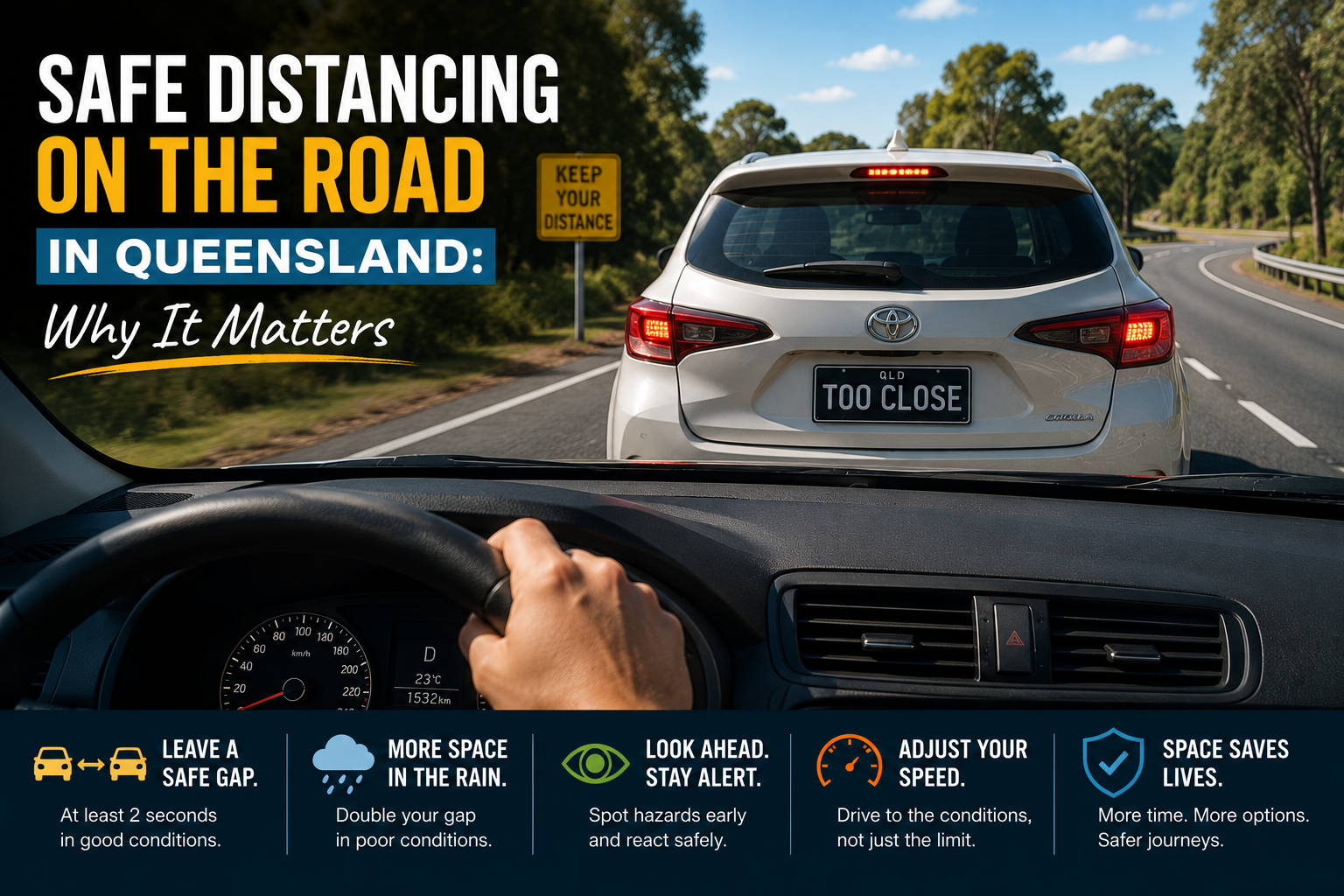
Safe Distancing on the Road in Queensland: Why It Matters
When learning to drive, it is easy to focus on speed limits, traffic lights, roundabouts and giving way.
But one of the simplest and most important skills you can develop is knowing how much space to leave between your vehicle and the one in front.
Following too closely—often called tailgating—reduces the time you have to see a problem, react and stop safely. Queensland road rules require drivers to leave a sufficient distance behind the vehicle in front so they can stop safely if necessary.
For learner drivers, understanding safe following distances is about much more than memorising the two-second rule.
It is about giving yourself time, space and options.
Key Takeaways
- In good conditions, allow at least a two-second gap behind the vehicle in front.
- Increase your following distance when it is raining, visibility is poor or the road is slippery.
- Queensland guidance recommends doubling the gap to at least four seconds in poor conditions.
- A safe following distance gives you more time to recognise hazards and react safely.
- If you are towing a trailer or caravan, you need additional space.
- Never assume two seconds is always enough—the conditions around you matter.
- Tailgating increases the risk of rear-end crashes and can also result in a fine and demerit point.
Why Safe Distancing Matters
Imagine the vehicle in front of you suddenly brakes.
Perhaps traffic has stopped unexpectedly. A pedestrian may have stepped onto the road, an animal may have appeared, or the driver ahead may have reacted to something you cannot yet see.
If you are following too closely, you have very little time to:
- Recognise that something has changed.
- React.
- Apply the brakes.
- Bring your vehicle to a stop.
A safe gap gives you a buffer.
That buffer can be the difference between braking smoothly and being forced into a sudden emergency stop.
Queensland Government guidance recommends at least a two-second gap in good conditions for a standard car, with greater distances needed when conditions are poor or your vehicle requires more stopping distance.
The Two-Second Rule Explained
The easiest way to judge your following distance is to use the time-lapse method.
Choose a fixed object beside the road, such as:
- A power pole
- A road sign
- A tree
- A bridge marker
When the rear of the vehicle in front passes that object, start counting:
“One thousand and one, one thousand and two.”
If your vehicle reaches the same object before you finish counting, you are following too closely.
Slow down slightly and create more space.
The important thing to remember is that two seconds is a minimum guide for good conditions—not a target you should try to stay as close to as possible. Queensland driver-training guidance specifically emphasises adjusting the gap to suit the conditions and maintaining enough space for potential hazards.
Why a Car Length Is Not a Safe Measurement
Some drivers think leaving one or two car lengths is enough.
The problem is that the distance required to stop changes dramatically depending on your speed.
At low speeds, a couple of car lengths may provide enough room.
At highway speeds, that same physical distance could disappear in a fraction of a second.
This is why measuring your gap in time rather than metres is more useful.
The faster you are travelling, the further you will travel during those two seconds.
Your time gap remains the same, but the physical distance automatically increases as your speed increases.
Safe Distance Gives You Time to See Hazards
One of the biggest benefits of leaving space is that it improves your view of the road ahead.
If you are sitting directly behind another vehicle, particularly a large SUV, truck or bus, you may not be able to see what is happening in front of it.
You could miss:
- Brake lights further ahead
- Stopped traffic
- Roadworks
- Pedestrians
- Animals
- A hazard on the road
- A vehicle turning or changing direction
Queensland learner-driver guidance encourages drivers to look for hazards ahead of the vehicle they are following, giving them more time to react and plan their next move.
Space in front of your vehicle gives you a better view—and a better view gives you more time to make decisions.
Increase Your Distance in Wet Weather
Queensland weather can change quickly.
A road that was dry when you started your journey can become wet and slippery within minutes.
When it rains, tyre grip is reduced and your vehicle may take longer to stop.
Queensland Government guidance recommends doubling your following distance in wet or poor conditions. For a standard car, this means increasing from at least two seconds to at least four seconds behind the vehicle in front.
In wet conditions:
- Slow down.
- Leave more space.
- Brake smoothly.
- Avoid sudden steering movements.
- Keep your lights and windscreen clear.
- Watch for standing water and slippery surfaces.
Remember, the posted speed limit is not always the safest speed for the conditions.
What About Heavy Rain or Poor Visibility?
If visibility is poor because of heavy rain, fog, dust or darkness, you may need even more than a four-second gap.
You should always consider:
- How far ahead you can see.
- How slippery the road is.
- The condition of your tyres.
- Your speed.
- The amount of traffic around you.
If you cannot clearly see what is happening ahead, you need to give yourself more time to react.
A good question to ask yourself is:
If the vehicle in front stopped suddenly right now, could I stop safely without hitting it?
If the answer is no, you need more space.
Safe Distancing When Towing a Trailer or Caravan
If you are towing a trailer or caravan, your vehicle will generally require more distance to stop.
Queensland guidance recommends allowing at least two seconds for your vehicle, plus an additional second for every three metres of trailer or caravan in normal conditions. In poor or wet conditions, that following distance should be increased further.
For example, the extra distance gives you more time to:
- Brake gradually.
- Maintain control.
- Avoid sudden manoeuvres.
- Reduce the risk of trailer instability.
Towing changes the way your vehicle behaves, so giving yourself additional space is essential.
Don't Let Other Drivers Pressure You Into Tailgating
Sometimes another driver may be travelling slowly in front of you.
That does not mean you should drive close behind them to encourage them to speed up or move over.
Tailgating reduces your safety margin.
If someone is driving below the speed limit, remain patient and maintain a safe distance.
When it is safe and legal to overtake, you can do so. Until then, protect the space in front of your vehicle.
Similarly, if someone is following you too closely, avoid reacting aggressively. Queensland driver-training guidance recommends reducing speed if necessary and allowing the vehicle to pass when it is safe to do so.
Safe Distance Is More Than Avoiding a Rear-End Crash
Rear-end crashes are one of the most common types of crashes, and following too closely significantly reduces your margin for error.
But maintaining space can also help you:
- See hazards earlier.
- Brake more gradually.
- Avoid sudden steering.
- Reduce stress while driving.
- Make better decisions.
- Drive more smoothly.
- Avoid reacting to every movement of the vehicle ahead.
Good drivers are not constantly braking and accelerating because they are too close to the vehicle in front.
They leave enough space to anticipate what is happening and adjust smoothly.
What Does Queensland Law Say About Following Too Closely?
Queensland road rules require drivers to maintain a sufficient distance behind the vehicle in front so they can stop safely and avoid a collision if necessary.
There is no single distance that applies to every situation because a safe gap depends on factors such as:
- Your speed.
- Weather conditions.
- Road conditions.
- Visibility.
- The type of vehicle you are driving.
As of the current Queensland demerit point schedule, following too closely can attract 1 demerit point and a $402 fine.
However, the real reason to maintain a safe distance should not be avoiding a fine.
It is about protecting yourself, your passengers and everyone else around you.
A Simple Habit for Learner Drivers
As you drive, regularly ask yourself:
Can I see far enough ahead?
Do I have enough space to stop safely?
What could the vehicle in front do next?
Have the road or weather conditions changed?
These questions will help you develop good hazard perception and defensive driving habits.
The goal is not simply to maintain exactly two seconds at all times.
The goal is to create enough space for the situation you are in.
Final Thoughts
Safe distancing is one of the easiest defensive driving skills to learn, but it is also one of the most important.
The space between your vehicle and the one in front is not wasted space.
It is your thinking space, braking space and safety margin.
In good conditions, use the two-second rule as your minimum guide. When conditions become more difficult, increase the gap.
Rain, poor visibility, higher speeds, towing, fatigue and heavy traffic all mean you may need more time and more space.
The best drivers do not wait until something goes wrong before reacting.
They give themselves enough room to see the problem coming.
Frequently Asked Questions
How far should I stay behind the car in front in Queensland?
In good driving conditions, Queensland guidance recommends at least a two-second gap behind the vehicle in front. Increase this distance when conditions are poor.
How do I measure a two-second following distance?
Pick a fixed object beside the road. When the vehicle ahead passes it, count “one thousand and one, one thousand and two.” If you reach the object before finishing the count, you are too close.
Should I increase my following distance in the rain?
Yes. Queensland Government guidance recommends doubling your following distance in wet conditions. For a standard car, this generally means increasing from at least two seconds to at least four seconds.
Why is following too closely dangerous?
Following too closely reduces the time you have to recognise a hazard, react and stop safely. If the vehicle ahead brakes suddenly, you may not have enough room to avoid a collision.
What if someone is driving too slowly in front of me?
Remain patient and maintain a safe following distance. Do not tailgate. If there is a safe and legal opportunity to overtake, you can do so.
Do I need more space when towing a caravan or trailer?
Yes. Queensland guidance recommends allowing additional following distance when towing—at least two seconds for your vehicle plus an extra second for every three metres of trailer or caravan in normal conditions.
Can I get fined for tailgating in Queensland?
Yes. Queensland road rules require you to leave enough distance to stop safely. Following too closely can attract a fine and demerit point.
Is two seconds always enough?
No. Two seconds is a minimum guide for good conditions. You should increase your following distance when it is raining, visibility is poor, the road is slippery, you are towing or other conditions reduce your ability to stop safely.