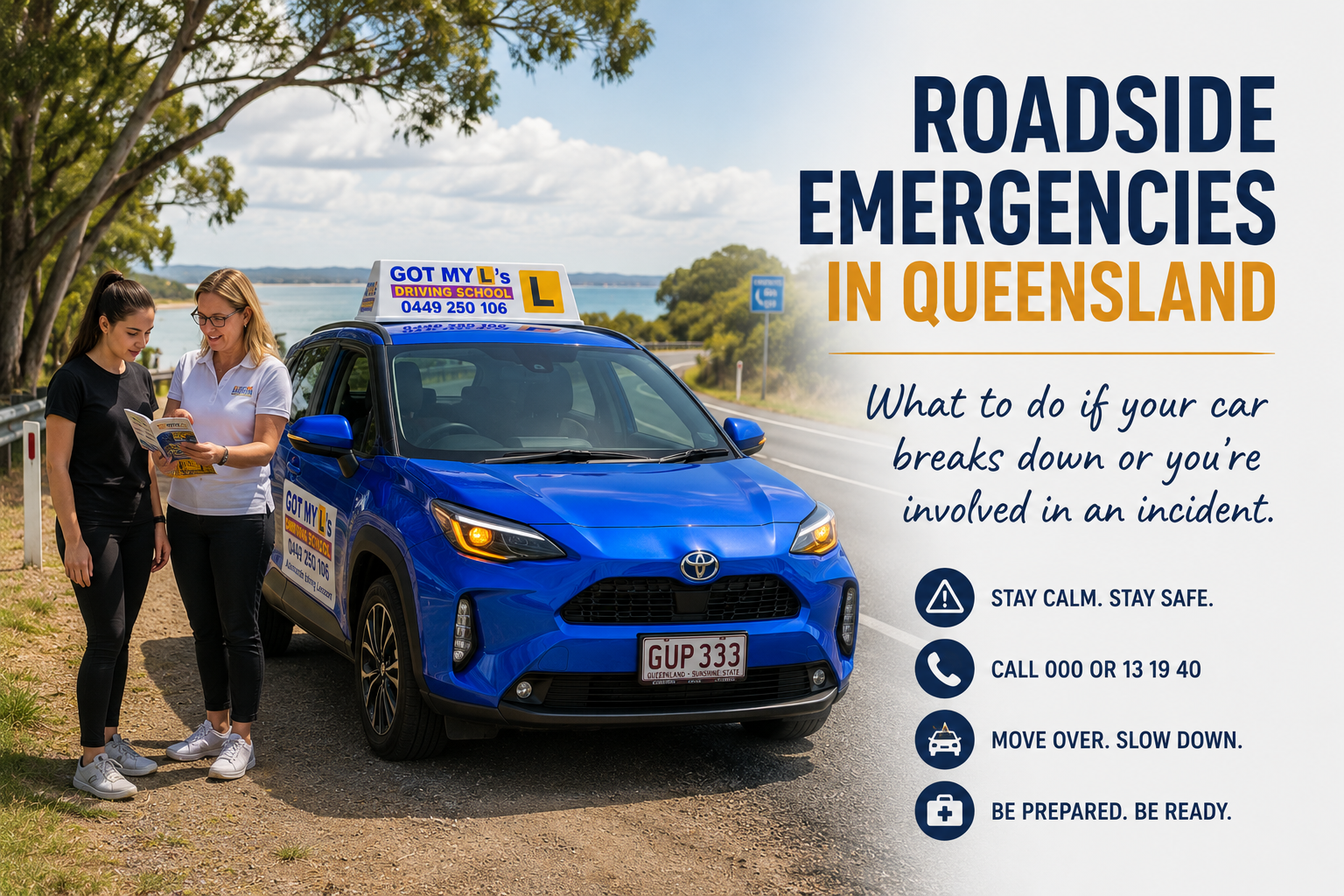
Roadside Emergencies in Queensland: What to Do If Your Car Breaks Down or You’re Involved in an Incident
Introduction
A roadside emergency can happen to any driver. A flat tyre, mechanical problem, crash, sudden storm or unexpected hazard can quickly turn an ordinary drive into a stressful situation.
Knowing what to do before something goes wrong can help you stay calm and make safer decisions.
Whether you're a learner driver, a newly licensed driver or an experienced motorist, understanding how to respond to a roadside emergency is an important part of safe driving in Queensland.
Key Takeaways
- Stay calm and focus first on getting yourself and your passengers out of immediate danger.
- If possible, move your vehicle away from traffic and turn on your hazard lights.
- On highways and motorways, try to exit the road if it is safe to do so.
- Call 000 if there is an immediate threat to life or serious injury.
- Call 13 19 40 to report a traffic incident, hazard or breakdown on a major Queensland road.
- Don't put yourself at risk trying to repair a vehicle beside fast-moving traffic.
- Move over and slow down when passing emergency response and roadside assistance vehicles where required and safe to do so.
- Prepare your vehicle before long trips and check weather and road conditions.
Understanding Road Safety During an Emergency
A roadside emergency is not always a major crash. It could be a flat tyre, overheating engine, mechanical failure, fallen debris or severe weather.
The most important thing is to avoid making the situation worse.
When something goes wrong, think about three priorities:
1. Get to a safer location
If your vehicle is still able to move safely, try to leave the traffic flow and pull over somewhere away from moving vehicles.
On a motorway or highway, Queensland Transport recommends exiting the road if possible. If you cannot safely reach an exit, pull onto the shoulder or as far away from traffic as possible.
2. Make your vehicle visible
Turn on your hazard lights to alert other drivers.
If visibility is poor because of rain, darkness or a severe storm, take extra care when pulling over and choose a location where other drivers have as much warning as possible.
3. Get help
For an immediate emergency involving serious injury, danger or a life-threatening situation, call 000.
For a breakdown, hazard or minor traffic incident on a major Queensland road, you can contact the Queensland traffic management service on 13 19 40.
Moving Over and Slowing Down for Emergency Vehicles
Queensland drivers have a responsibility to safely pass emergency response workers and roadside assistance providers.
When passing a parked emergency response vehicle displaying flashing lights, drivers must move over where it is safe and practical to do so.
On a multi-lane road, this generally means leaving a clear lane between your vehicle and the emergency response workers. If you cannot safely change lanes, move as far away as possible within your lane and slow down.
These rules can apply to:
- Police vehicles
- Ambulances
- Fire and emergency services
- Transport enforcement vehicles
- Tow trucks
- Roadside assistance vehicles
The flashing lights may be blue, red, yellow or magenta depending on the type of vehicle.
The important thing is not to make a sudden or dangerous manoeuvre. Safety always comes first.
Preparing for a Safer Journey
The best roadside emergency is the one you avoid.
Before heading out, particularly on a long trip, take a few minutes to check your vehicle.
A simple pre-trip checklist
- Check your tyre condition and pressures.
- Make sure your lights are working.
- Check your fuel level.
- Ensure your windscreen is clean and your wipers work properly.
- Carry a charged mobile phone.
- Save your roadside assistance contact details.
- Consider keeping a high-visibility vest and torch in the vehicle.
- Check weather and road conditions before travelling.
Queensland's current wet-weather and emergency preparation guidance also recommends checking tyre tread, lights and visibility equipment before travelling.
For longer trips, it is also sensible to carry water, a first-aid kit and other basic emergency supplies.
What to Do If Your Vehicle Breaks Down
Breaking down can be stressful, especially for new drivers.
The key is to stay calm and focus on getting away from moving traffic.
Step 1: Try to reach a safe location
If you notice a problem while driving, don't panic.
If your vehicle can still be driven safely, indicate and move towards a safer location.
On a motorway or highway, try to reach the next exit if it is safe to do so.
If you cannot exit, pull onto the shoulder or as far away from traffic as possible.
Step 2: Turn on your hazard lights
Hazard lights help warn approaching drivers that your vehicle is not moving normally or has stopped.
Step 3: Think carefully before leaving the vehicle
On high-speed roads, standing beside your vehicle or walking along the road can be extremely dangerous.
If it is safe to leave the vehicle, Queensland's motorway breakdown guidance recommends exiting away from traffic and moving to a safer location. If leaving the vehicle would put you in greater danger, stay focused on keeping yourself and your passengers as safe as possible while waiting for assistance.
Step 4: Call for assistance
Contact your roadside assistance provider or call 13 19 40 if you need assistance with a breakdown or minor incident on a major Queensland road.
Staying Safe on Motorways and High-Speed Roads
Motorways and highways create additional risks because vehicles are travelling at higher speeds.
If you break down:
- Try to exit the motorway if it is safe.
- Pull as far away from traffic as possible if you cannot exit.
- Turn on your hazard lights.
- Do not attempt repairs beside fast-moving traffic.
- Do not walk along a motorway or highway looking for help.
- Contact roadside assistance or 13 19 40.
Queensland Transport specifically advises against stopping to assist another motorist on a motorway or highway because doing so can create an additional hazard. If you see a breakdown, report it when safe to do so and move over and slow down as you pass.
What to Do When You See Another Vehicle Broken Down
Your first instinct might be to stop and help, but on a busy or high-speed road this can create another dangerous situation.
Instead:
- Stay alert for hazard lights, a stopped vehicle or a raised bonnet.
- Slow down.
- Move over safely where possible.
- Keep watching for people who may be outside the vehicle.
- If you believe assistance is needed, report the breakdown when it is safe to do so.
On Queensland motorways and highways, drivers are advised not to stop and pull over to assist because of the danger created by additional vehicles stopping near fast-moving traffic.
Driving During Severe Weather and Natural Disasters
Queensland weather can change quickly.
Heavy rain, storms and flooding can dramatically affect road conditions and visibility.
Before travelling during severe weather:
- Check current weather warnings.
- Check road conditions.
- Ask yourself whether the trip is really necessary.
- Allow extra travel time.
- Make sure your vehicle is prepared.
If conditions become unsafe, find a safe place to stop rather than trying to push through.
And one rule should always be clear:
If it's flooded, forget it.
Queensland's flood safety guidance warns that vehicles can lose steering, engine power and electrical systems in floodwater, even when drivers believe the water is shallow or manageable.
Preparing an Emergency Kit for Your Vehicle
A basic vehicle emergency kit can be particularly useful for long trips or travelling through regional Queensland.
Consider carrying:
- First-aid kit
- Drinking water
- Torch and spare batteries
- High-visibility vest
- Phone charging cable or power bank
- Basic tools
- Sunscreen
- Insect repellent
- Hat
- Blanket
- Non-perishable snacks
Get Ready Queensland also recommends preparing your vehicle and carrying emergency supplies, particularly when travelling in areas affected by severe weather or natural disasters.
FAQ
Q: What should I do if my car breaks down in Queensland?
Turn on your hazard lights and, if possible, move your vehicle away from traffic. On a motorway or highway, try to reach an exit if it is safe. If you cannot, pull as far away from traffic as possible and contact roadside assistance or 13 19 40 for assistance on a major Queensland road.
Q: Should I get out of my car if I break down?
It depends on where you are and the immediate danger around you. On high-speed roads, being outside your vehicle can be dangerous. Queensland's breakdown guidance recommends moving to a safer location away from traffic when it is safe to do so. Always assess the situation carefully rather than automatically getting out of the vehicle.
Q: What number should I call for a roadside emergency?
Call 000 if there is a serious emergency or immediate threat to life.
For a traffic incident, hazard, breakdown or assistance on a major Queensland road, call 13 19 40.
Q: What should I do when approaching an emergency vehicle stopped on the road?
Move over where safe and practical and slow down while passing. On multi-lane roads, Queensland's rules generally require drivers to leave a clear lane between their vehicle and emergency response workers where possible.
Q: Should I stop to help someone whose car has broken down?
On a motorway or highway, Queensland Transport advises against stopping to assist because this can create another dangerous situation. Instead, report the breakdown when it is safe to do so and continue safely.
Q: What should I keep in my car for an emergency?
Useful items include water, a first-aid kit, torch, high-visibility vest, phone charger, basic tools and protection from the Queensland sun and weather.
Q: Should I drive through floodwater if I think my car can handle it?
No. Queensland's official advice is simple: If it's flooded, forget it. Floodwater can affect steering, electrical systems and vehicle control regardless of the type of vehicle you are driving.