Driver Distraction – It Only Takes a Second
When people think about the causes of road crashes, they often think of speeding, drink driving or fatigue. While these are major contributors, driver distraction is another serious risk that can have devastating consequences.
Losing concentration for just a few seconds can be enough to miss a hazard, drift from your lane or fail to react in time to avoid a crash.
Common driving distractions
Some of the most common distractions behind the wheel include:
- Talking on a mobile phone.
- Reading or sending text messages.
- Scrolling through music or changing the radio station.
- Adjusting the GPS while driving.
- Eating or drinking.
- Attending to children or pets in the vehicle.
- Looking at passengers instead of the road.
Safe drivers keep their eyes on the road, their hands on the wheel and their full attention on driving.
Mobile phone rules in Queensland
Using a mobile phone while driving is heavily regulated in Queensland.
It is illegal to hold a mobile phone in your hand or rest it on any part of your body while driving, even if you are stopped at traffic lights. This applies whether the phone is being used or not.
Drivers who break these rules may receive:
- A substantial fine.
- Demerit points.
- Increased crash risk for themselves and others.
Extra restrictions for learner and P1 drivers
If you hold a Learner Licence or are a P1 Provisional driver under 25 years of age, the rules are even stricter.
You must not use a mobile phone in any way while driving, including:
- Hands-free devices.
- Bluetooth connections.
- Loudspeaker mode.
- Headsets or earbuds.
Your full attention should always be on the road.
Every second counts
Travelling at 100 km/h, your vehicle covers almost 28 metres every second.
Looking away from the road for just two seconds means you've travelled more than 55 metres without properly watching where you're going.
That's enough distance to miss a stopped vehicle, a pedestrian, a cyclist or changing traffic conditions.
Tips to avoid distractions
Before you start driving:
- Set your GPS before moving off.
- Choose your music or playlist.
- Put your phone on silent or activate "Do Not Disturb While Driving."
- Secure loose items.
- Make sure children are safely restrained before leaving.
Once you're driving, focus on driving. If something needs your attention, pull over somewhere safe before dealing with it.
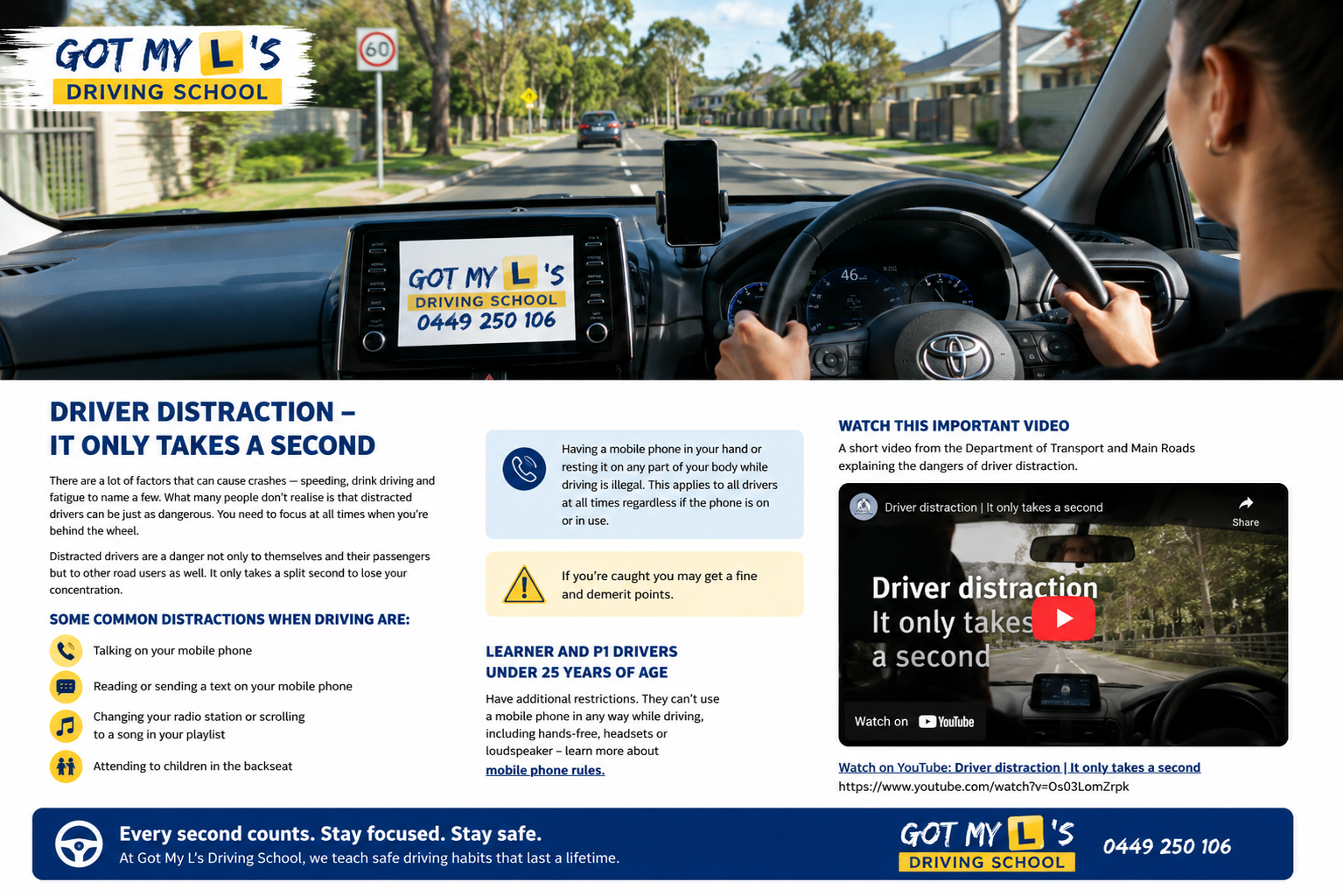
Learn safe driving habits from day one
At Got My L's Driving School, we teach learner drivers that passing the driving test is only the beginning. Developing safe driving habits—like avoiding distractions—helps reduce crash risk and builds confidence behind the wheel.
Remember: No text, phone call or playlist is worth risking a life. Stay focused every time you drive.